what we do

What I’ll Be Doing For Preservation Week

I’ll be examining books, documents and works of art on paper at two Preservation Week events in Denver.  Should be fun!

April 26th I’ll be with the Society of Rocky Mountain Archivists (SRMA) at the Denver Public Library from 10:30-12:30.

In celebration of Preservation Week, Denver Public Library Western History/Genealogy and the Society of Rocky Mountain Archivists are providing short preservation consultations for your family treasures with conservation experts on Monday April 25th at the Denver Public Library.
Staff from the Denver Public Library Western History/Genealogy Department will be on hand digitizing your artifacts for inclusion in the new WHG website “Creating Your Community,” to launch in the Fall. If you would like a copy of your image to take home with you immediately, bring a thumb drive or disk and we’ll give you a TIF of your image.
Monday, April 25, 10:30a – 3p
Gates Meeting Room, Level 5
Denver Public Library
10 W. 14th Ave. Parkway
Denver, Colorado 80204
To guarantee a session with a conservator, make a reservation through srmapreservation@srmarchivists.org or call 303-275-2214.
Walk-ins welcome as time allows.
* experts in the conservation of books, paper, photographs, textiles, paintings and objects will be available
Due to logistical constraints, objects larger than 36”
cannot be accommodated.

UPDATE: EVENT CANCELED: May 1, 12-4  is the DUArt! Conservation Roadshow.  This is a fundraiser for DUArt!, an organization that provides scholarships to art students at the University of Denver.

Join a group of art professionals:
conservators specializing in paper, paintings, and objects, an appraiser, a frame specialist, a gemologist, and a collections management professional, to learn about the preservation of your collections and heirlooms!
Consultations with the specialists will help you to assess:

 Condition
 Options for Treatment
 Value Characteristics
 Archival Framing Options
 Preventive Measures
 Optimum Environment
 Management of a Collection
Participants are invited to bring an object from their own collection for examination. Concurrent sessions will culminate in a discussion of interesting objects and preservation issues.
RSVP early; space is limited.  Registration Form
Admission: $50.00 ($65 non-members) for all participants bringing objects
or for those only observing: $25.00 DU ART! members
$35.00 for non-members

art conservation, what we do

On Collaboration

Friend and Smithsonian Conservator Nora Lockshin wrote a lovely post on The Bigger Picture: Visual Archives and The Smithsonian about her research on artist Adelia Gates in response to my question on a watercolor I treated.  At the end of her post she wrote about the serendipity of finding mention of a flower in Gates’s writings, and of that flower being present in the painting I worked on.  Another layer of serendipity unfolded for me upon reading this – Adelia Gates found that flower by rock-climbing in Colorado.  As the director of the American Alpine Club Library, which is the world’s largest resource on mountaineering and climbing, that full-circle pleases me no end.

what we do

Blue Shield Statement on Egypt

I am simply republishing this statement from Blue Shield in its entirety to help raise awareness of this issue and the organization itself. For more information, please visit the links embedded in the statement.

***********************

Following the recent events in Egypt, the Blue Shield expresses its great concern about the safeguarding of the country’s invaluable cultural heritage amid the existing turmoil.

Starting last Friday evening, a number of important museums and sites in Egypt have fallen prey to looters. Thankfully, in certain cases, it has been reported that members of civil society stood to protect museums and heritage sites all over the country. This demonstrates not only the attachment of the local population for their cultural heritage and their determination to protect it, but also the vulnerability of cultural institutions, sites and monuments during times of great conflict.

It is universally recognised that Egypt has an incomparable history and heritage which has had a profound and lasting influence on peoples throughout the world. Any loss of Egyptian cultural property would seriously impoverish the collective memory of mankind. Egypt has an exceptionally rich cultural heritage and it is imperative that every precaution necessary be taken by all sides involved in this strife to avoid destruction or damage to archives, libraries, monuments and sites, and museums.

Blue Shield urges all sectors of Egyptian society to do everything in their power to curb or prevent all actions that could result in the damage or destruction of their cultural heritage. The Blue Shield also praises the courageous citizens of Cairo and the rest of Egypt who spontaneously mobilized to protect the Egyptian Museum and other cultural institutions. We call on all Egyptians to continue giving the fullest support to all efforts to prevent damage to heritage sites and institutions throughout the country.

The Blue Shield Mission is “to work to protect the world’s cultural heritage threatened by armed conflict, natural and man‐made disasters”. For this reason, it places the expertise and network of its member organisations at the disposal of their Egyptian colleagues to support their work in protecting the country’s heritage, in assessing the damage that has occurred, and for subsequent recovery, restoration and repair measures.

The member organisations of the Blue Shield are currently liaising with Egyptian colleagues to obtain further information on both the situation and on the possible needs and types of help required so as to mobilise their networks accordingly.

A more complete report on damages, needs and actions will be published subsequently, in order to facilitate coordination.

The Blue Shield

The Blue Shield is the protective emblem of the 1954 Hague Convention which is the basic international treaty formulating rules to protect cultural heritage during armed conflicts. The Blue Shield network consists of organisations dealing with museums, archives, audiovisual supports, libraries, monuments and sites.

The International Committee of the Blue Shield (ICBS), founded in 1996, comprises representatives of the five Non-Governmental Organisations (NGOs) working in this field:

National Blue Shield Committees have been founded in a number of countries (18 established and 18 under construction). The Association of National Committees of the Blue Shield (ANCBS), founded in December 2008, will coordinate and strengthen international efforts to protect cultural property at risk of destruction in armed conflicts or natural disasters. The ANCBS has its headquarters in The Hague.

Contact Information: secretariat.paris@blueshield‐international.org

The actions of the Blue Shield can also be followed on

List all IFLA news


what we do

When Hats Collide

First woman jury, Los Angeles (LOC)

Originally uploaded by The Library of Congress

As the lone full-time staffer of a tiny library with big ambitions and significant collections, I wear a large number of hats. Sometimes they war with each other. It’s hard to tell which hat is the Top.

Take this week, for instance. In the archives is a tattered Alaskan flag which was brought to the summit of Mt. Vinson, Antarctic for the first ascent in 1966. The flag was subsequently lost, and then retrieved by another expedition, and by a circuitous route involving much research and several countries returned to a member of the original summit party, who then donated it to the institution for which I work. Another mountaineer asked to bring the flag back with him on a reunion mission to the same peak this week. I carefully packed it up and wrote “fragile” all over it and handed it over, never thinking he meant to actually carry it back to the summit and unfurl it. Yesterday I read that that was the plan. The hats immediately started hopping about as if there were rabbits under each.

My conservator hat anxiously says the flag should never leave its foam bed in the archives so that it can last several hundred more years. My curator hat says that it’s a great story and an interesting kind of living history exhibit, vastly improved by its new associations.

My pragmatist hat says it’s an interesting thing, but only a thing and if the human carrying it is safe then it will be safe, and if neither is safe then we’ve got bigger problems. My flat out curmudgeon hat says “mine mine mine do what I say!” My library marketeer hat (similar to a mouseketeer hat?) says that we can get a lot of publicity mileage of it and none of that is bad.

My teacher hat says do what I say not what I do, because if everybody sent their archives into space or to high altitude, our cultural heritage would be in shreds. My renegade hat (or maybe beret?) says screw it, it’s really cool and things are made to be used not hidden. My preservationist hat says I’m entrusted with these things and need to keep them home and safe no matter how compelling the argument. My registrar hat says it’s just a very unusual type of temporary exhibit loan.

That’s a lot of hats talking. And the fact of the matter is that the flag went to the Ice and will come back no worse for the wear from its big adventure, enriched by a greater history – and if not, well, I made a mistake. I’m curious – what would you do, those of you who are not curtailed by traditional collection management policies? Next time someone wants to carry a one-of-a-kind item on a meaningful quest, should I send it?

UPDATE (1/13/11): I just read this post on Dan Cull’s blog that illuminates, I think, some of the rabbits under my hats.  These two thoughtful people are always worth reading, and I am very glad to see that Kevin Drieger is blogging again!

art conservation, what we do

Zen and the Art of Backing Removal

Click on the image to see more photos

Peeling an acidic window mat away from the front of a very fragile watercolor may not sound like a fun way to spend a few hours to most people. To me, once I get beyond the fear of doing damage, it is extremely satisfying meditation.

At first, I pry about with different tools, feeling my way to find which scalpel, which knife will work the best with the very particular nature of the paper to be removed. Some move down to the artwork’s surface too quickly for safety. Others are not sharp enough, or are too sharp, or have to be held at the wrong angle. As I work, though, I find the combination and sequence of tools, the right angle, the best direction. I begin to feel as though I understand the way the fibers lay and how to move the tools to lift them with less effort. I enter a bit of a trance, a zone. There is trial and error and a narrowing of attention to the minute level of micron-thick layers of paper that become my world.

I have to remind myself not to get too comfortable – there is always a fragment of something stuck in the paper to block the way, a clump of glue that trips the knife and brings it close to piercing the soft paper of the artwork below, but a sense of right movement develops. It is akin to any other kind of sustained focus, like writing well, or the kind of running that is fast and light and free. I want to go forever. I become mind-less in the best zen sense.

My hand starts to cramp and my neck strained from keeping it at such an odd tilt, but I want to keep going, unwilling to let the learning go, knowing I’ll have to relearn the paper and the flow of the knife the next time I sit down to work on this project. I stop, clean up, and realize I am much calmer than when I first sat down – the reward of silent focus and one of the best parts of this job.

what we do

Full Circles

Yesterday I sat in on a conversation facilitated by Nina Simon which focused, in part on the idea of object-mediated interactions with strangers.  The cited chapter is from her book, The Participatory Museum, which I really am looking forward to reading.   She is a ball of fire and full of creative ideas backed up by solid research.

At any rate, our conversation led me to reflect on the ways, past, present and possibly future, that I have used objects that way.  Once upon a time, I was an art therapist, and I used looking at art and making art as a way to help people talk about their situations and the ways they’d like to change.  I particularly remember a kid who built and smashed ceramic cars as a way to deal with his brother’s death in a car accident.  He didn’t talk about it, he just did it.  Eventually, he started talking about the accident to others, and he got better.

Around that same time, I ran an adult art play group in a coffee house called Downtown Grounds.  It was the early 90s and coffee houses were dark, warehouse-y places, and I provided the supplies for people to contribute art to a group theme or for their own private art-making off in a candle-lit corner.  As a shy person, it was great to be able to have a reason to be there, to be the facilitator.  One of our group members yesterday talked about liking that role of attracting others by doing rather than by approaching them, and that lead to a conversation about the different ways people engage in unfamiliar territories, as voyeur, as participant, as facilitator.

I realized that I am in the position to engage strangers around objects in several different ways in my work today.  In my private conservation work, strangers bring their valued objects to me to fix, and we generally have some sort of conversation about why they are valuable and interesting.  That is a very rewarding part of my job, and it gives me some joy to know the reason behind the work I am doing.

In my work as preservation librarian, I get to talk to people about the objects they love when they donate them to the archive, and I get to talk to people about their responses to objects in the collection when they see them for the first time, or even when they come back to visit them again, or to show them to someone else.  There is so much pleasure in that kind of connection, because these strangers have a passion about things that allows them to interact with me in a deeper level than in most casual encounters, and it allows me to learn about the items and the culture of the collection/collectors, which in turns deepens my passion for preserving them and for providing access.

The future? Well, in moving the museum and library closer together, there will be more opportunities to engage visitors with physical objects and their on-line representations.  I’m at the Museums and the Web 2010 conference, which is all about finding ways to tell the stories of objects.  I am full of ideas, inspired by strangers from all over the world attending this conference.  I am really looking forward to getting started!

ADDED 3/17/10: I can’t believe I forgot to add my largest object-mediated interaction:

Uncategorized, what we do

Sometimes The Paper Talks To You

I  like the meditation of working silently focused on a document, finding the right texture of paper for a fill, fiddling around with acrylic paints to tone it the right color, creating a tiny beveled edge and pasting the mend in so it fits just so.  Often, I am looking and thinking so much about the paper fibers, the way the pigment is laid onto the weave, the way the tear is broken, that I don’t really notice what the art portrays, or what the document says.

Sometimes, the work is going smoothly and I allow my mind to wander a bit.  Today was such a day, and when I found myself remembering a bunch of Yiddish words, turning them over in my mind, I was a bit puzzled. I haven’t heard Yiddish spoken since I was a teenager.  No one in my life now speaks Yiddish, but there they were: “Hey, schmendrick, what are you doing?  Are you meshugana?  What’s this mishegas?”  (Translation: Hey, moron…are you nuts?  What’s this craziness? – I’m not sure why my inner Yid is so insulting…)

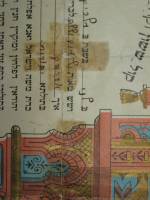
Then I realized.  I am working on a Ketuba.  A Jewish marriage certificate.  Aha! The subject matter creeps in, even when you think you aren’t paying attention.  I spend a few minutes thinking about family long gone, and turn back to the mending.

what we do

Lament to a BookBinder, and My Reply

Well, it’s a new year and time for a new look on the blog.  I’ve had the same template since 2007, and things have changed around here!

I found this on my pages, and didn’t want to lose it from the web completely, so it will now live here as a post, with this caveat:

Potential Clients – please don’t let this frighten you. Too much 🙂

In 2003, this was posted to the Book Arts List. Bieler Press has printed a broadside of Non Libri Sed Liberi , known as the Lament To A Bookbinder, from Kenneth Grahame’s essay of the same title (from The Pagan Papers, 1898)

Writing in 1898 Kenneth Grahame noted that:

“As a general rule, the man in the habit of murdering bookbinders, though he performs a distinct service to society, only wastes his own time and takes no personal advantage”

In 1904 Grahame expanded on that thought, perhaps because some book had still not been completed/delivered

“Not in that he bindeth books – for the fair binding is the final crown
and flower of painful achievement – but because he bindeth not: because
the weary weeks lapse by and turn to months, and the months to years,
and
still the binder bindeth not: and the heart grows sick with hope
deferred.

Each morn the maiden binds her hair, each spring the honeysuckle binds
the cottage porch, each autumn the harvester binds his sheaves, each
winter the iron frost binds lake and stream, and still the binder
bindeth
not.

Then a secret voice whispereth: ‘Arise, be a man, and slay him! Take
him
grossly, full of bread, with all his crimes broadblown as flush as May;
at gaming, swearing, or about some act that hath no resish of salvation
in it!’

But when the deed is done, and the floor strewn with fragments of
binder –
still the books remain unbound…”

And I replied:

The BookBinder Cometh
in her good time
Be ye faithful and rest
knowing the Muse guides
the binding hand
Should not a work of excellence
be worth the wait,
even as the maiden’s hair does grey,
and winter’s frost deepen?

As Seasons do they turn
so coins turn, from palm to palm
golden in the sun,
and When they drop
from thy purse
as apples drop in
bountiful harvest
Know thy book will
be come to thee.
Tell me not of your
overwrought spending,
when I spend bone and
finger and breath
without recompense
for your Reward.

As for slaying,
that choice be mine
for the frequency with which
seeking boots cross
the threshhold
Beware, for sharpened knives
rest atop my bench.
I would as soon slit flesh
than paper.
Begone, beggar,
and return when you
are sent for.

(beth heller, 2003)

what we do

Name That Thing

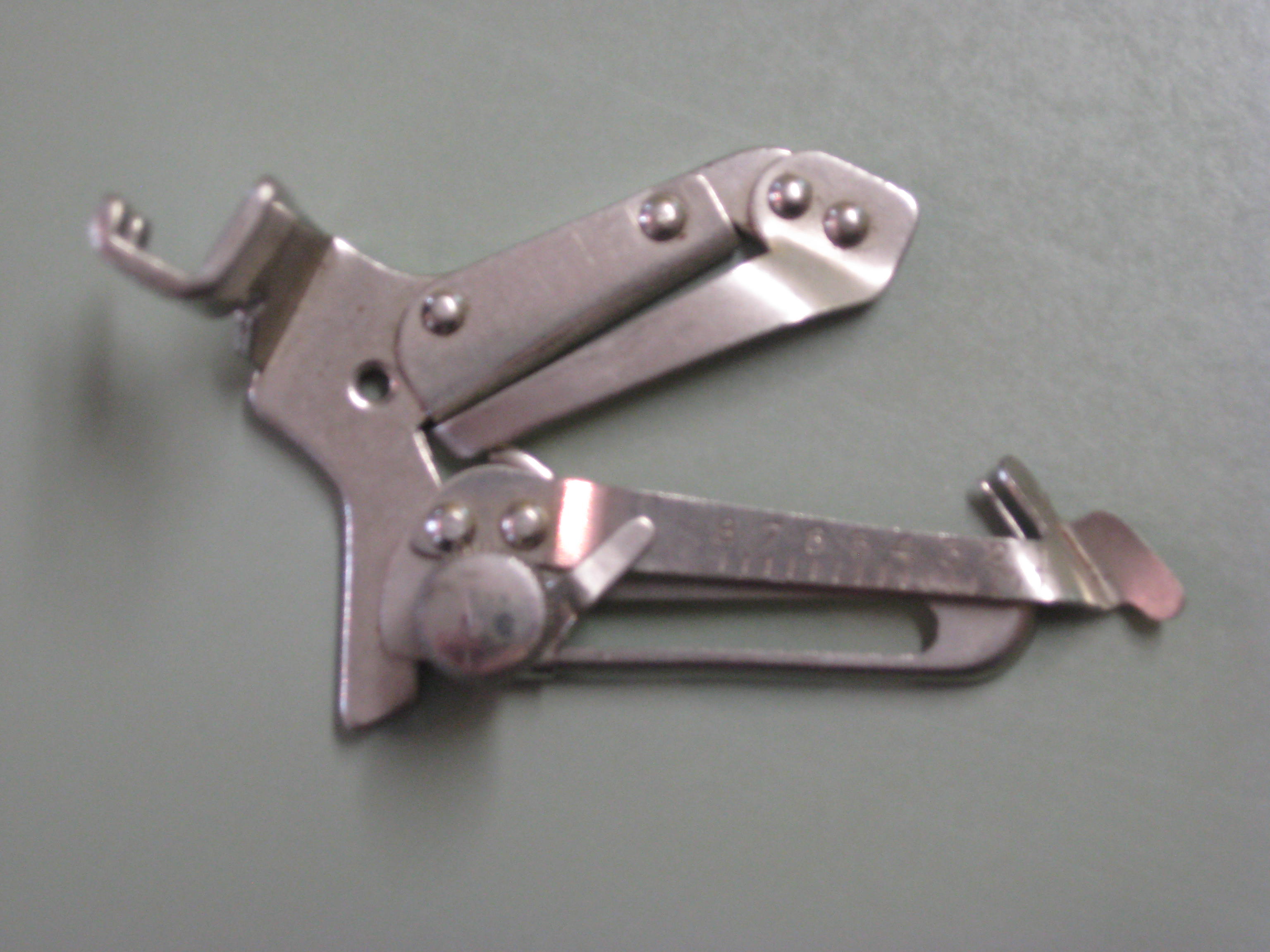
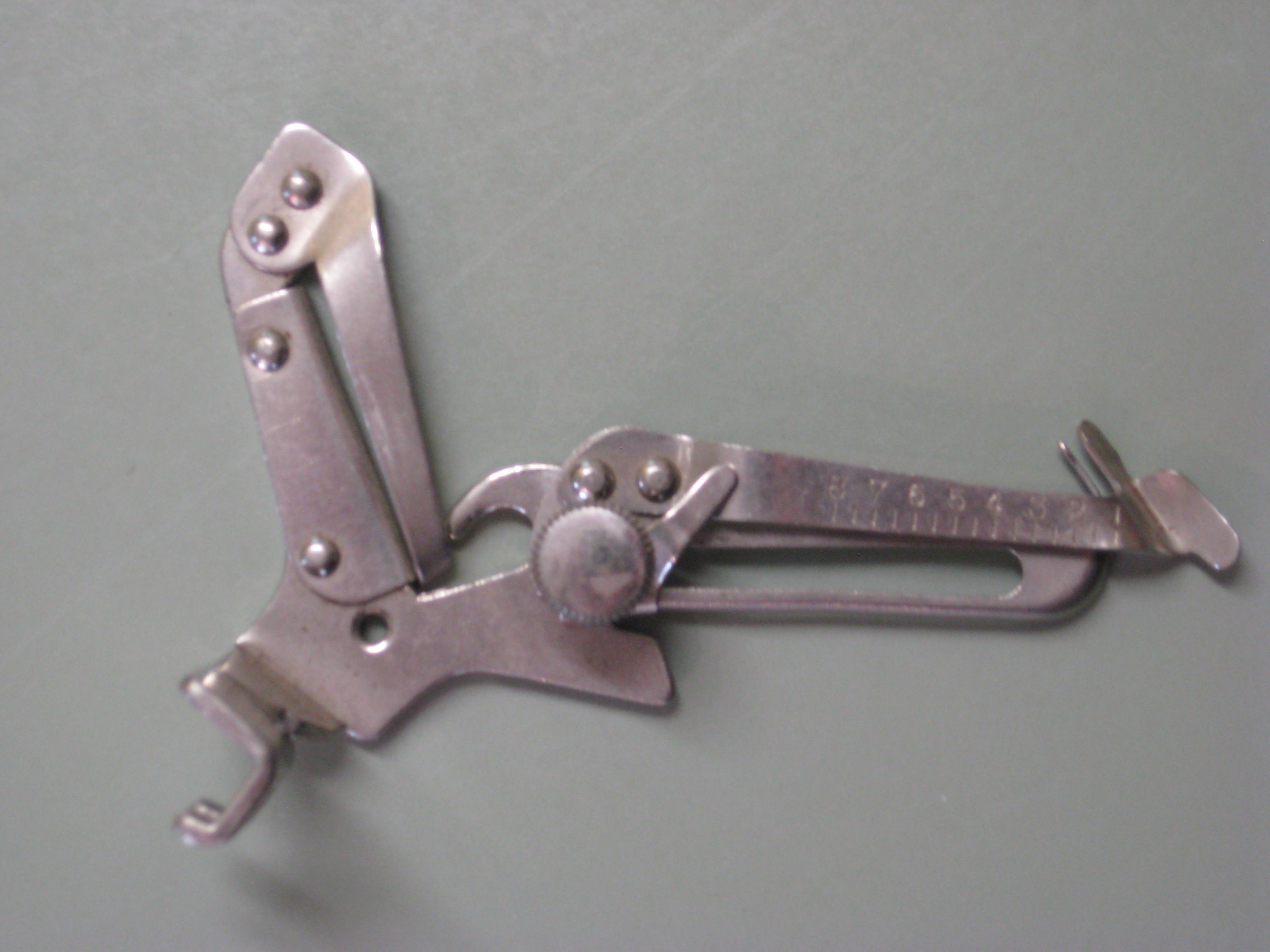
As mentioned before, I’ve been unpacking.  Among the hundreds of pencils, the boxes of staples that demonstrate the history of staple packaging and the wealth of leather and decorative paper, I’ve found a variety of things I cannot name.  Here is one:

What is it?
I have no idea

The measurement ticks are 1/8″ apart and the knob turns to loosen or lock down the measurement aspect of the device. The whole thing is 2 1/4″ long and there are hooks on the upper left for attaching it to something.  I’m sure someone out there must know what it is and that I will feel stupid when they tell me.  Anyone? Jeff Peachy?

what we do

Cary Peck’s Stuff Is In The House

I have been busy unpacking the bindery items I purchased from Cary Peck.  You can see photos of her and read about her career in this PDf version of a 2004 Guild of Bookworkers interview.  One of the most interesting comments she makes is about her early days of training and work:

“Four months after my decorative paper class at the Y, I started as a bookbinder with a ruler, a pair of scissors and a hair comb. My shop was my kitchen table with my work board on top. With 6 kids to raise by myself, I had one clean spot to work. To close down the shop, everything went onto the work board and under my bed.”

I certainly remember what it was like to work on a desk top narrower than the board I was trying to cut at the Benson Latin American Library, with a straight edge, sort of, and a couple of glue brushes, but there were not 6 kids clamoring for my attention at the time.  I feel very lucky to now have the workspace that I do, surrounded by the love of the people who helped me build it.  I’m hoping Cary’s determination and focus will hover near me while I work – and maybe I’ll get to bind a radio too! (read the article and you’ll see what I mean.)